
Love That Fix combines measured observations with practical home-repair knowledge to help you make sense of indoor air, humidity, moisture, ventilation, water-condition and EMF/RF questions, then decide what deserves attention next.
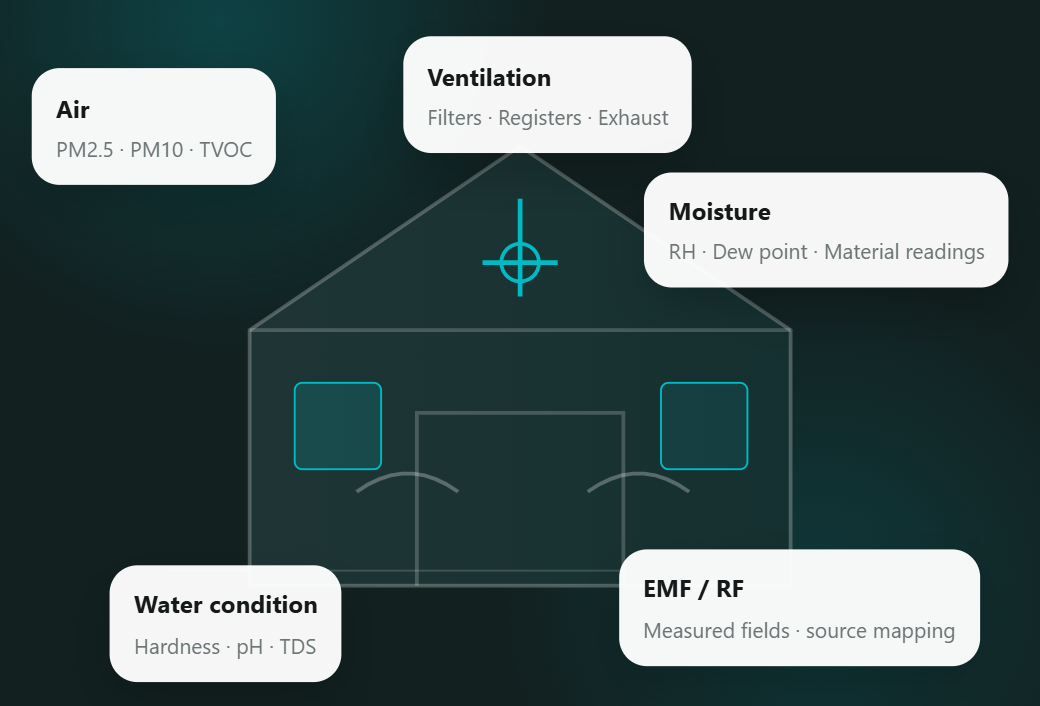
Professional service in your home
Measured readings and observed conditions
Johnson County and Kansas City Metro service
Measurements considered alongside how the home functions
A reading is most useful when it answers a real question. Start with what you are seeing or noticing, then use the right measurements and observations to narrow the possibilities.
Recurring condensation
Windows, bathrooms or other surfaces repeatedly collect moisture, and you want to understand the humidity, temperature and ventilation conditions around it.
Persistent dampness
A room, basement or lower level feels consistently humid, or visible finish damage returns after a cosmetic repair.
Airflow feels uneven
Some rooms feel stagnant or exhaust and ventilation do not seem to be working as expected.
Water leaves heavy scale
Mineral buildup or fixture deposits are raising questions about hardness, conditioning or plumbing choices.
You want measurements before making changes
Instead of replacing equipment or starting repairs based on guesswork, you want useful baseline information first.
Love That Fix uses screening, measurement and home-condition observations to build practical context. The exact scope depends on the concern, accessible conditions and available equipment.
INDOOR AIR & VENTILATION
Use measured air and comfort indicators together with basic ventilation observations—not a single number in isolation.
PM2.5 / PM10
TVOC screening
CO checks / screening
Temperature, RH & dew point
Psychrometer readings
Ventilation observations
A screening reading does not replace functioning carbon-monoxide alarms or emergency guidance. CDC guidance emphasizes properly installed CO detectors in the home.
Moisture problems often make more sense when visible conditions, humidity and material readings are considered together.
Moisture-meter screening
Condensation conditions
Bathroom humidity
Exhaust observations
Basement / lower-level dampness
Water-entry patterns
EPA homeowner guidance emphasizes moisture control and addressing water sources. Love That Fix does not provide mold remediation or certified mold clearance.
Basic water-condition screening can help with scale, fixture and water-conditioning questions. It is not a substitute for laboratory contaminant analysis.
Hardness
pH
Total dissolved solids (TDS)
Water conditioning
Fixture & plumbing context
Definitive contaminant analysis
This service documents measured fields, signal differences and source locations. Love That Fix does not provide medical or health-risk interpretation of EMF/RF readings.
Electric-field measurement
Magnetic-field measurement
RF signal mapping
Source location
Equipment-location suggestions
Health interpretation
Good screening creates context, not a pass/fail label for your home. The most useful result is a clearer decision about what to monitor, adjust, repair or investigate next.
Different concerns call for different measurements. A useful screening can gather only the categories that matter to your question, without turning the home into a one-number health score.
Love That Fix does not invent universal indoor “pass” values. Measurement duration, equipment, context and the specific question all matter.
What matters is what the reading means for the home, and whether anything actually needs attention.
Not every measurement means something needs to be replaced.
Improve or verify ventilation
Where observations point to a supported exhaust, airflow or filter issue, Love That Fix can discuss practical next steps within scope.
Address a moisture source
Where screening points toward water entry, drainage, downspouts or a more involved moisture correction, the dedicated Drainage, Moisture & Water-Damage Solutions service may be the appropriate next step.
Consider water conditioning
Hardness or scale concerns may support water-softener, water-conditioning or fixture recommendations within applicable scope.
Use a qualified laboratory or specialist
Definitive contaminant testing, specialized trade evaluation, formal engineering or other work outside Love That Fix’s scope should go to the appropriate qualified provider.
Monitor before changing anything
Sometimes the right answer is to collect more context, watch a pattern over time or leave a stable condition alone.
The scope should fit the question. Love That Fix does not need to measure everything in the house simply because the equipment exists.
Share the area, pattern, recent leaks or changes, and any useful photos or videos.
Love That Fix identifies which readings or observations may be useful for the concern.
Collect appropriate readings and observe relevant accessible home conditions.
Explain measured conditions in practical, homeowner-friendly language.
Monitor, maintain, repair, improve ventilation, use a lab or refer to a qualified specialist as appropriate.
Love That Fix connects observed conditions to how the home actually functions—moisture, ventilation, plumbing, drainage, fixtures, maintenance and repair.
Krissie holds a Bachelor’s Degree in Health Sciences from UMKC. That background informs the company’s attention to moisture, ventilation, clean work practices and the indoor environment; it is not presented as medical or environmental certification.
The goal is to understand the condition behind recurring damage or discomfort instead of automatically treating only the visible finish.
Screening can connect naturally to supported ventilation, plumbing, water-conditioning, drainage or repair work when corrective action is actually appropriate.
The same relationship can move from the initial concern to repair planning or qualified referral without pretending every issue belongs to Love That Fix.
Love That Fix emphasizes protecting surrounding surfaces, minimizing dust and debris where possible, moisture awareness and thorough cleanup.
Home Health & Indoor Environment Screening is available across Love That Fix’s service area, subject to scheduling and the screening scope.
It is a practical screening, measurement and diagnostic-support service. Depending on the concern, Love That Fix may collect indoor-air, humidity, moisture, ventilation, water-condition or EMF/RF measurements and combine them with observations of accessible home conditions to help identify sensible next steps.
No. Love That Fix provides screening and measurement within its supported scope. Laboratory-grade contaminant analysis, certified clearance or specialized environmental testing should be performed by the appropriate qualified provider.
Supported screening may include PM2.5, PM10, TVOC, temperature, relative humidity, dew-point / moisture-condition evaluation, psychrometer readings and appropriate carbon-monoxide screening where the equipment and scope allow. Ventilation observations may also include filters, registers, vents, airflow and exhaust conditions.
Love That Fix does not perform mold remediation or claim certified mold clearance. Moisture-meter screening, humidity readings and home-environment observations may help identify conditions that warrant qualified mold or laboratory evaluation.
Love That Fix can provide measurements, observations and diagnostic support to help narrow likely home-condition factors. Some situations may require further HVAC, building-science or other specialist evaluation depending on the source and scope.
Love That Fix can provide basic screening such as hardness, pH and TDS where appropriate. Those readings do not prove water is free of contaminants. Heavy metals or other definitive contaminant analysis should use an appropriate qualified laboratory.
It documents measured electric, magnetic and radiofrequency signals and can help compare locations or identify likely sources. Love That Fix does not provide medical, toxicity or health-risk interpretations of EMF/RF measurements.
Supported ventilation improvements, plumbing, water conditioning, drainage, moisture correction and other home repairs may be handled separately within applicable trade and local requirements. Where the issue falls outside Love That Fix’s scope, a qualified specialist may be recommended.
Tell Love That Fix what you are noticing, where it happens and whether there have been recent leaks, HVAC changes, plumbing changes or renovation work. We’ll help determine what screening scope makes sense.
We Fix It. You Love It.
Woman-owned professional home repair and project services serving Johnson County, Kansas and the greater Kansas City Metro.
Standard residential calls are generally concentrated around Johnson County; farther travel may be considered for larger, recurring or specialty work.
© 2026 Love That Fix. All rights reserved. Powered by Catalyst Creatives Co.